-
1.
What Is an Essential Building Materials List?
-
2.
Building Materials and Their Uses
-
3.
A: Structural Materials
-
4.
B: Masonry and Walling Materials
-
5.
C: Roofing Materials
-
6.
D: Insulation and Waterproofing
-
7.
E: Plumbing and Electrical Materials
-
8.
F: Finishing Materials
-
9.
How to Choose the Right Residential Construction Materials
-
10.
Getting Your Materials List Right from the Start
Most people think a house build begins when the excavator turns up. It doesn’t. It begins much earlier, on paper, with a proper list of what you actually need to put the thing together. Get that essential building materials list right and a lot of headaches simply never happen. Whether it’s a brand new build in Canberra or a knockdown rebuild, knowing your materials, and their uses, makes budgeting easier, cuts down on delays, and gives you a home that holds up over time.
What follows is a run through of the core residential construction materials used in most Australian homes. We’ve gone stage by stage, and noted what each material actually does along the way.
What Is an Essential Building Materials List?
Put simply, it’s a detailed inventory of everything needed to build a home from the ground up. The list sorts building construction and materials into sensible groups, structural, masonry, roofing, plumbing, electrical, and finishing being the main ones.
For homeowners and builders both, it works as a planning tool. Procurement gets smoother, budgets stay tighter, and quality control has something to measure against. Here in Australia there’s another reason it matters: it helps make sure your materials line up with the National Construction Code (NCC) and the relevant Australian Standards. That part isn’t optional. It’s what gets you through inspections and keeps the build sound for years down the track.
Building Materials and Their Uses
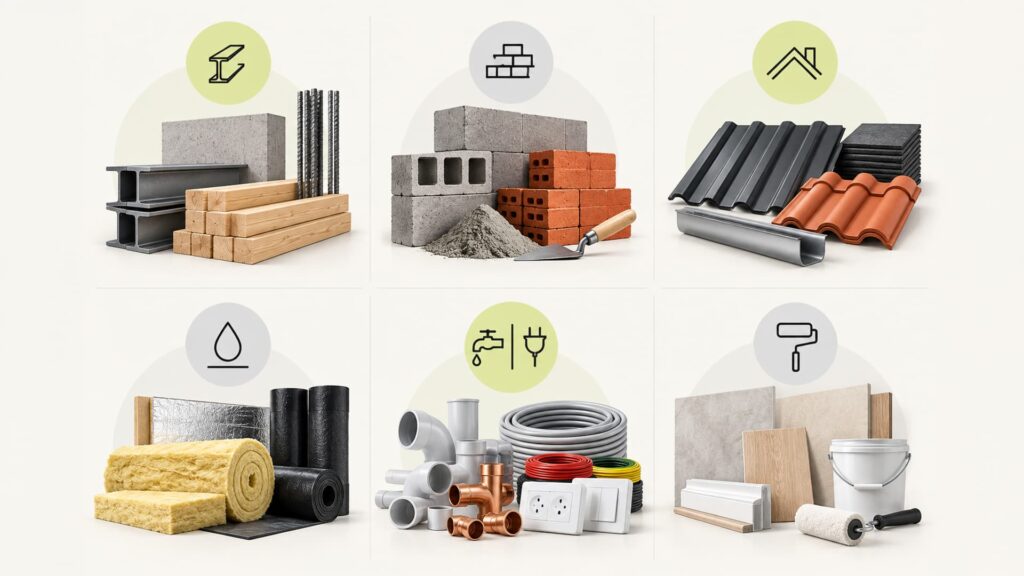
If you understand building materials and their uses, everything else on a project gets easier. So here’s a practical breakdown of the house construction materials that most Australian homes depend on.
A: Structural Materials
- Concrete does the heavy lifting, literally. It’s a mix of cement, sand, aggregate and water, and it forms footings, slabs, driveways and structural columns. Anywhere the load is greatest, concrete tends to be involved, because it’s strong and it lasts.
- Cement is the binder that holds concrete and mortar together. Most Australian builds run on general purpose (GP) cement, though blended cements are getting more popular now, mainly for the lower carbon footprint.
- Steel reinforcement, the reo bar and mesh, sits inside the concrete to create reinforced concrete. Concrete is brilliant under compression but weak in tension, and steel handles the tension. That’s the whole reason slabs and footings are always reinforced.
- Sand and aggregates are the bulk of what goes into concrete and mortar. Aggregates alone make up a large share of concrete by volume, and they’re a big part of what gives it strength and stability.
B: Masonry and Walling Materials
- Bricks and blocks turn up everywhere in Australia, external walls, retaining structures, feature elements. Clay bricks suit our climate nicely; they’ve got good thermal mass and don’t ask for much maintenance. Concrete blocks tend to get used for boundary and retaining walls.
- Timber framing is the standard way most Australian houses are framed. Treated pine and hardwood go into wall frames, roof trusses and flooring joists. Timber’s versatile, it’s renewable, and it goes up quickly, which counts for a lot on site.
- Mortar is what bonds the bricks and blocks, made from cement, sand and lime.
C: Roofing Materials
The roof cops it, Australia’s sun and rain are hard on anything up top, so roofing has to earn its keep.
- Colorbond steel is a national favourite, and for good reason: durable, bushfire resistant, and available in more colours than you’ll probably need.
- Concrete and terracotta tiles are still popular too, partly for the classic look and partly because they last. Underneath all that, sarking and insulation deal with heat and moisture.
D: Insulation and Waterproofing
Our climate swings hard, so insulation, whether batts, boards or reflective foil, is essential. It keeps the home energy efficient and it’s needed to meet the NCC’s thermal performance rules.
- Waterproofing membranes are the other half of the equation, protecting wet areas, balconies and below ground walls from moisture that would otherwise cause real damage.
E: Plumbing and Electrical Materials
- Plumbing materials cover PVC and copper pipes, fittings, tapware and sanitary fixtures, the things that bring clean water in and take waste out.
- Electrical materials are the cabling, switchboards, power points and lighting that move power safely around the house. Both have to be installed by licensed tradespeople to meet Australian regulations. No exceptions there.
F: Finishing Materials
This is where the project starts looking like a home. Finishing materials for homes include:
- Plasterboard for internal walls and ceilings
- Tiles for kitchens, bathrooms and living areas
- Paint and render for protection and appearance
- Doors, windows and glazing for access, light and energy efficiency
- Flooring, be it timber, laminate, carpet or vinyl
How to Choose the Right Residential Construction Materials
Spending a bit more on quality building materials and construction products upfront usually saves money and stress later. A few things worth weighing up:
- Climate suitability. Australian conditions demand materials rated for UV, moisture and, in a lot of regions, bushfire (that’s your BAL ratings).
- Compliance. Materials need to meet the NCC and Australian Standards.
- Durability versus cost. Cheap materials often just mean more repairs later. Sometimes the saving isn’t a saving at all.
- Sustainability. Low carbon cement, responsibly sourced timber, energy efficient glazing, these add real long term value.
- Supplier reliability. A reputable supplier gives you consistent quality and, importantly, warranties.
Getting Your Materials List Right from the Start
A properly thought out essential building materials list is often the difference between a build that runs smoothly and one that doesn’t. Once you understand building materials and their uses, the decisions at every stage, from footings to finishes, get a good deal clearer.
Planning a new home in Canberra and after some expert guidance on quality materials and the craftsmanship to match? The team at Abode Constructions can help bring your vision to life. Get in touch and start the conversation about your dream home.